
The Northern Corridor Transit and Transport Coordination Authority (NCTTCA) provides the institutional mechanism for implementation of the Agreement. The Authority brings together Member States and Corridor stakeholders to coordinate policies, monitor implementation, address constraints affecting trade and transport, and promote joint regional initiatives.
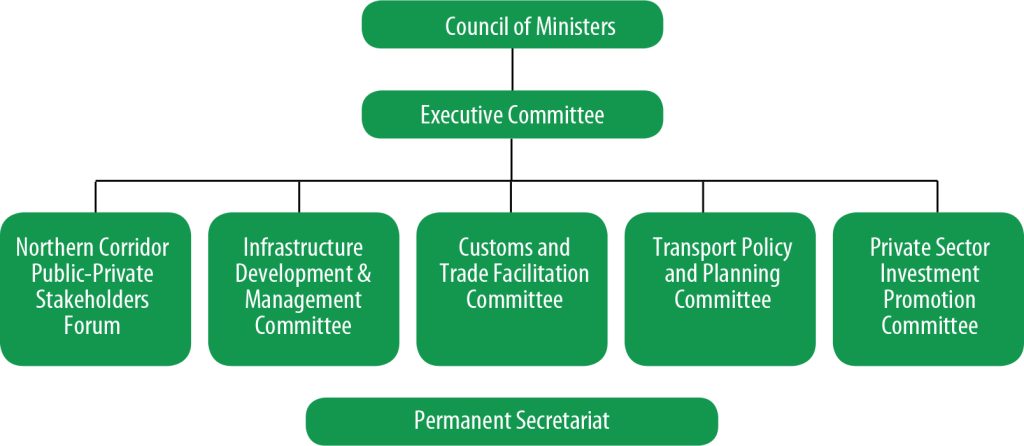
The Agreement establishes several organs of the Authority:
The highest policy-making organ of the Authority, comprising Ministers responsible for transport matters in the Member States. Its decisions on implementation of the Agreement are binding on the Contracting Parties.
Comprising Permanent Secretaries or equivalent senior officials responsible for transport matters. The Executive Committee supports policy formulation, oversees implementation and promotes uniform application of the Agreement and its Protocols.
Technical committees bring together relevant institutions and experts from Member States to develop implementation strategies and address specialised transport and transit issues.
Specialized committees which are in place to synthesize and make appropriate recommendations to the Executive Committee include:
The executing organ is the Permanent Secretariat based in Mombasa, Kenya. It is charged with the responsibility of implementing the Northern Corridor Transit and Transport Agreement; and any other decisions and resolutions made by the Council of Ministers and the Executive Committee. Below is the NCTTCA Institutional Structure.
Provides a platform through which public- and private-sector stakeholders identify operational challenges, develop recommendations and participate in implementation of decisions affecting Corridor trade and transport.
The Permanent Secretariat is the administrative and management organ of the Authority and coordinates the day-to-day implementation, monitoring and follow-up of the Agreement and decisions of the NCTTCA policy organs.